




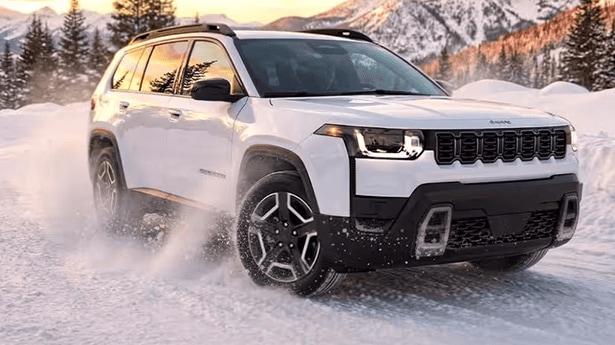
For most daily commuters facing Northeast Ohio winters, an all-wheel drive system is the strong choice because it engages automatically to distribute engine torque across variable road conditions like wet slush and patchy snow. Drivers who frequently tackle deep, unplowed snow drifts, heavy towing, or rugged terrain will benefit more from a selectable four-wheel drive system with low-range gearing.
Deciding between all-wheel drive (AWD) and four-wheel drive (4x4) comes down to how and where you drive when winter weather hits. All-wheel drive operates continuously behind the scenes, using electronic sensors to detect wheel slip and send power to the tires with the most grip in milliseconds. This seamless operation makes AWD vehicles, such as the Dodge Durango or the Jeep Grand Cherokee equipped with Quadra-Trac I or Active Drive I, remarkably easy to handle on everyday highway commutes and suburban streets.
In contrast, traditional 4x4 systems, like those found on the Ram 1500, lock the front and rear axles together to deliver maximum traction through deep snow banks and unplowed secondary routes. Many modern 4x4 models offer automatic settings alongside manual 4-High and 4-Low modes, giving drivers tailored control over demanding terrain. Commuters visiting our showroom often ask whether AWD or 4x4 is better for everyday snow before comparing specific models on the lot, and our team helps match each vehicle's hardware to individual driving routines.
For families driving near the Lake Erie shoreline in Willoughby, automatic traction switching offers instant reassurance when sudden winter squalls hit. Before winter arrives, stop by our dealership located at 36845 Euclid Ave to explore our inventory, give our team (440) 597-2588 a call with any technical questions, or submit an online application to apply for financing before your visit.
What Are the Key Technical Differences Between AWD and 4x4 Systems?
All-wheel drive continuously monitors wheel traction using electronic sensors and differentials to automatically send power to wheels with grip, whereas four-wheel drive uses a mechanical transfer case to lock the front and rear axles together at a fixed speed ratio. This locked distribution provides maximum power in heavy snow, but requires careful engagement to avoid mechanical stress on dry roads.
The mechanical architecture defines how each drivetrain manages power distribution:
- All-Wheel Drive (AWD): Uses a center differential or electronically controlled clutch pack to allow the front and rear wheels to rotate at different speeds. This mechanical flexibility lets AWD remain permanently engaged on dry asphalt, wet pavement, ice, and packed snow without driver intervention.
- Four-Wheel Drive (4x4 or 4WD): Utilizes a two-speed mechanical transfer case that locks the front and rear driveshafts together. When engaged in 4-High or 4-Low, both axles receive equal torque. Because the axles are locked, turning on dry pavement forces the tires to scrub, causing drivetrain binding.
- Automatic 4WD Systems: Feature an "Auto" setting within the transfer case that uses electronic clutches to simulate AWD behavior on pavement while retaining true mechanical 4-Low lockup for extreme off-road or deep snow scenarios.
Engine options across our lineup demonstrate how these drivetrains deliver power. For example, select Jeep Grand Cherokee models feature a 2L engine producing 324 hp and 332 lb-ft of torque, while others utilize a 3.6L engine delivering 293 hp and 260 lb-ft of torque, both paired with an efficient TorqueFlite® 8-speed automatic transmission.
When evaluating pre-owned options for winter commuting, understanding whether a vehicle uses continuous AWD or selectable 4x4 helps ensure you select the right mechanism for your daily drive. You can explore our selection of pre-owned vehicles to compare different drivetrain configurations in person.
Engine & Performance
Powertrain specs by trim
| Feature | 85th Anniversary Edition | Laredo | Laredo 4x4 | Laredo Altitude |
|---|---|---|---|---|
| :-- | :-- | :-- | :-- | :-- |
| Engine | 2L | 3.6L | 3.6L | 2L |
| Horsepower | 324 hp | 293 hp | 293 hp | 324 hp |
| Torque | 332 lb-ft | 260 lb-ft | 260 lb-ft | 332 lb-ft |
| Transmission | TorqueFlite® | TorqueFlite® | TorqueFlite® | TorqueFlite® |
| Drivetrain | All-wheel drive | Rear-wheel drive | All-wheel drive | Rear-wheel drive |
Engine & Performance (continued)
| Feature | Laredo Altitude 4x4 | Laredo X | Laredo X 4x4 | Limited |
|---|---|---|---|---|
| :-- | :-- | :-- | :-- | :-- |
| Engine | 2L | 3.6L | 3.6L | 2L |
| Horsepower | 324 hp | 293 hp | 293 hp | 324 hp |
| Torque | 332 lb-ft | 260 lb-ft | 260 lb-ft | 332 lb-ft |
| Transmission | TorqueFlite® | TorqueFlite® | TorqueFlite® | TorqueFlite® |
| Drivetrain | All-wheel drive | Rear-wheel drive | All-wheel drive | Rear-wheel drive |
Engine & Performance (continued)
| Feature | Limited 4x4 | Limited Reserve 4x4 | Summit 4x4 |
|---|---|---|---|
| :-- | :-- | :-- | :-- |
| Engine | 2L | 2L | 2L |
| Horsepower | 324 hp | 324 hp | 324 hp |
| Torque | 332 lb-ft | 332 lb-ft | 332 lb-ft |
| Transmission | TorqueFlite® | TorqueFlite® | TorqueFlite® |
| Drivetrain | All-wheel drive | All-wheel drive | All-wheel drive |
When Would 4x4 Be a Better Fit Than AWD for Northeast Ohio Driving?
When tackling unplowed back roads or hauling heavy trailers in Northeast Ohio winters, a selectable four-wheel drive system offers superior control and power. Low-range 4x4 gearing multiplies engine torque at slow speeds, giving vehicles the mechanical advantage needed to pull out of heavy snowdrifts where standard all-wheel drive clutches might slip or overheat.
While AWD excels on managed roads, 4x4 shines when road conditions disappear entirely under several inches of unplowed accumulation. Pickup trucks and dedicated off-road SUVs utilize 4x4 systems to maintain low-speed momentum through heavy drifts that would high-center lighter passenger crossovers. Key advantages of choosing a 4x4 system include:
- Low-Range Gearing (4-Low): Multiplies engine torque to crawl out of deep snowbanks or steep ditches without burning clutch packs.
- Mechanical Axle Lockers: Forces left and right wheels on the same axle to turn together, ensuring forward movement even if three tires lose traction completely.
- Superior Ground Clearance: Most 4x4 trucks and SUVs feature elevated ride heights, preventing snow from packing beneath the undercarriage and immobilizing the vehicle.
Vehicles equipped with advanced traction management systems, such as Jeep's Selec-Terrain dial, allow drivers to select specialized Snow or Mud modes to tailor throttle response and transmission shift points. To find a rugged vehicle built for tough winter conditions, browse our certified pre-owned lineup for factory-backed trucks and SUVs.
How Much Does AWD or 4x4 Reduce Overall Fuel Economy?
Equipping a vehicle with all-wheel drive or four-wheel drive typically reduces fuel economy by 1 to 3 miles per gallon compared to an equivalent two-wheel drive model. This efficiency difference stems from the added mechanical weight of extra driveshafts and differentials, along with continuous rotational friction within the drivetrain.
The fuel economy impact varies based on drivetrain design and driving habits:
- Weight Drag: AWD and 4x4 hardware adds roughly 100 to 300 pounds of curb weight to the chassis, requiring slightly more energy to accelerate.
- Parasitic Loss: Rotating extra gears, axles, and driveshafts creates mechanical resistance that absorbs engine horsepower before it reaches the road.
- Disengagement Tech: Modern vehicles reduce fuel loss by using front-axle disconnect systems that mechanically uncouple drivetrain components when extra traction is not needed, recovering highway efficiency on clear roads.
- Seasonal Factors: Winter fuel blends, prolonged engine warming idling, and cold tire pressures often lower winter fuel economy more significantly than the drivetrain itself.
For commuters driving along the Lake Erie basin toward Mentor, the minor fuel efficiency trade-off of an all-wheel drive system is well worth the peace of mind during unpredictable morning commutes. If you are considering upgrading to a more efficient winter-ready vehicle, check your current vehicle value using Kelley Blue Book Instant Cash Offer to see how much trade equity you can apply toward your next purchase.
Fuel Economy
Fuel economy and range by trim
| Feature | 85th Anniversary Edition | Laredo | Laredo 4x4 | Laredo Altitude |
|---|---|---|---|---|
| :-- | :-- | :-- | :-- | :-- |
| MPG | 20 city / 25 hwy / 22 combined | 19 city / 26 hwy / 22 combined | 19 city / 26 hwy / 22 combined | 21 city / 27 hwy / 23 combined |
Fuel Economy (continued)
| Feature | Laredo Altitude 4x4 | Laredo X | Laredo X 4x4 | Limited |
|---|---|---|---|---|
| :-- | :-- | :-- | :-- | :-- |
| MPG | 20 city / 25 hwy / 22 combined | 19 city / 26 hwy / 22 combined | 19 city / 26 hwy / 22 combined | 21 city / 27 hwy / 23 combined |
Fuel Economy (continued)
| Feature | Limited 4x4 | Limited Reserve 4x4 | Summit 4x4 |
|---|---|---|---|
| :-- | :-- | :-- | :-- |
| MPG | 20 city / 25 hwy / 22 combined | 20 city / 25 hwy / 22 combined | 20 city / 25 hwy / 22 combined |
Does AWD Help Your Vehicle Stop Faster on Ice or Replace Winter Tires?
All-wheel drive does not help a vehicle stop faster on ice or snow because braking distance depends entirely on tire traction and the vehicle's braking system, not on which wheels receive engine power. While AWD aids acceleration and forward momentum on slippery surfaces, dedicated winter tires with cold-weather rubber compounds and deep sipes are essential for shortening stopping distances and maintaining steering control.
All passenger vehicles feature four-wheel braking regardless of whether they are front-wheel drive, rear-wheel drive, AWD, or 4x4. Pressing the brake pedal engages brakes on all four wheels equally. Drivetrain configuration only affects how engine power is sent to the tires during acceleration, not how the vehicle decelerates.
Winter tires play a critical role in cold-weather performance:
- Rubber Compound Flexibility: All-season tire rubber hardens when temperatures drop below 45°F, reducing grip on dry asphalt and ice alike. Winter tires remain soft and pliable in sub-freezing weather.
- Sipe Technology: Thousands of micro-grooves in winter tire treads bite into packed snow and ice, channeling slush away from the contact patch.
- Braking Distance Comparison: A front-wheel drive vehicle fitted with winter tires will stop significantly shorter on snow and ice than an AWD vehicle riding on worn all-season tires.
Combining an AWD or 4x4 system with snow-rated tires delivers the ultimate combination of acceleration, cornering stability, and braking safety. To explore winter-capable crossovers and SUVs equipped with the latest safety features, view our broad inventory of new vehicles today.
How Does Lake-Effect Snow Impact Road Conditions in Northeast Ohio?
Lake-effect snow creates rapid, hyper-localized weather shifts where dry pavement can turn into several inches of slush and near-zero visibility within a matter of miles. These intense squalls drop heavy, moisture-laden snow that quickly packs into ice under tire pressure, making fast-reacting automatic traction systems critical for maintaining stability.
As cold arctic air flows across the warmer open waters of Lake Erie, it absorbs moisture and rises, forming narrow, dense bands of intense snowfall. These snow bands can dump several inches of wet snow per hour over specific corridors while areas just a few miles away remain clear. This extreme variability creates distinct driving hazards:
- Sudden Surface Friction Changes: Drivers moving at highway speeds can abruptly transition from clear pavement directly onto slick slush.
- Rapid Freezing: Moisture dropping onto sub-freezing pavement freezes instantly under traffic compaction, creating hidden black ice.
- Visibility Drops: Whiteout conditions require responsive electronic stability control and antilock braking systems to keep the vehicle tracking straight.
Automatic AWD systems excel in lake-effect conditions because they adapt instantly to traction changes without requiring the driver to take their hands off the wheel or manually engage a transfer case.
Common Questions About 4x4 and AWD Vehicles in Northeast Ohio
Q: Does driving in four-wheel drive on dry pavement harm the transfer case?
Yes, operating a traditional 4x4 system in 4-High or 4-Low on dry, high-traction pavement causes drivetrain binding. Because 4x4 locks the front and rear driveshafts together, the inner and outer wheels cannot rotate at different speeds when turning. This resistance puts severe strain on the transfer case, axles, and tires. Drivers should only engage manual 4x4 modes on loose surfaces like snow, ice, gravel, or mud.
Q: Should I keep my vehicle's drive mode in Snow mode all winter long?
Snow mode is best reserved for active snowfall, slush, and icy road conditions rather than clear winter driving. Engaging Snow mode alters throttle sensitivity, adjusts transmission shift points to start in higher gears, and tunes traction control to minimize wheelspin. On clear, dry pavement, leaving the system in Snow mode may result in sluggish acceleration and reduced fuel efficiency. Returning to Auto or Normal mode on clear roads ensures optimal efficiency.
Q: How does cold winter weather affect tire pressure sensors and AWD performance?
Ambient air temperature drops cause tire pressure to decrease by approximately 1 PSI for every 10°F drop in temperature. Uneven tire pressure across four wheels alters the effective rolling diameter of the tires, which can cause the electronic control unit of an AWD system to detect false wheel slip or overheat drivetrain clutches. Maintaining proper inflation pressures listed on the driver's door jamb helps preserve AWD performance and system longevity throughout the winter.
Q: Can I install winter tires on only two wheels of an all-wheel drive vehicle?
No, winter tires must always be installed as a complete set of four on all-wheel drive and four-wheel drive vehicles. Mixing tires with different tread depths, rubber compounds, or traction levels creates uneven tire circumferences and varying grip levels between axles. This imbalance damages AWD center differentials and transfer cases while causing unpredictable handling, tail-sway, or loss of steering control on slick surfaces.
Q: What documentation should I prepare before applying for vehicle financing?
To streamline your vehicle purchase, gather current proof of income (such as recent pay stubs or tax documents), proof of residency (a recent utility bill), a valid driver's license, and current auto insurance information. If you plan to trade in a vehicle, bring the vehicle title or lien payoff information along with all sets of keys. Having these documents ready speeds up the approval process with our finance department.
Explore Winter-Ready Vehicles at Chrysler Dodge Jeep Ram
Choosing the right drivetrain comes down to balancing your daily driving route with the extreme winter weather patterns of Northeast Ohio. Chrysler Dodge Jeep Ram of Willoughby offers an extensive selection of new and pre-owned 4x4 trucks and AWD crossovers equipped to handle lake-effect snow and icy roads with confidence.
Whether you prefer the automatic convenience of an AWD Jeep Grand Cherokee with MSRP starting at $50,415 for the 85th Anniversary Edition, a Laredo trim with MSRP starting at $38,920 (or $40,920 in 4x4), a Laredo Altitude 4x4 with MSRP of $46,360, a Limited 4x4 with MSRP at $46,320, or a Summit 4x4 with MSRP at $60,600, our team is here to guide your search. We also offer Laredo Altitude with MSRP at $44,360, Laredo X with MSRP at $41,415 (or $43,415 in 4x4), and Limited Reserve 4x4 with MSRP at $51,915.
Visit our showroom at 36845 Euclid Ave to test drive our winter-ready lineup today, or call our team at (440) 597-2588 to discuss current inventory and schedule your visit.
Pricing
Pricing by trim
| Feature | 85th Anniversary Edition | Laredo | Laredo 4x4 | Laredo Altitude |
|---|---|---|---|---|
| :-- | :-- | :-- | :-- | :-- |
| Base MSRP | $50,415 | $38,920 | $40,920 | $44,360 |
| Destination charge | $1,995 | $1,995 | $1,995 | $1,995 |
Pricing (continued)
| Feature | Laredo Altitude 4x4 | Laredo X | Laredo X 4x4 | Limited |
|---|---|---|---|---|
| :-- | :-- | :-- | :-- | :-- |
| Base MSRP | $46,360 | $41,415 | $43,415 | $44,320 |
| Destination charge | $1,995 | $1,995 | $1,995 | $1,995 |
Pricing (continued)
| Feature | Limited 4x4 | Limited Reserve 4x4 | Summit 4x4 |
|---|---|---|---|
| :-- | :-- | :-- | :-- |
| Base MSRP | $46,320 | $51,915 | $60,600 |
| Destination charge | $1,995 | $1,995 | $1,995 |
*Prices and MSRP referenced in this article are estimates for informational purposes only and do not constitute an offer to sell. See dealer for complete details. *Fuel economy estimates shown may differ from official EPA ratings and should not be relied upon as a guarantee of actual vehicle performance.